

Google's ads business violates antitrust laws, should break up, EU says
Earlier this year, the U.S. Department of Justice sued Google for breaking antitrust laws with
2023-06-15 01:19

Tokens delisted, exchange closed following SEC crypto lawsuits
Just days after the U.S. Securities and Exchange Commission (SEC) sued crypto exchanges Binance and
2023-06-10 05:45

Scientist shares what 'probably' caused the Titan submersible to implode
A well-known biochemist has shared a compelling analysis of what “probably” caused the Titan submersible to implode. Philip E. Mason, who goes by the username Thunderf00t on YouTube, said the main reason why the tiny OceanGate vessel failed was “so painfully simple” that he initially thought he must be making a “boneheaded mistake” in his calculations. However, he acknowledged, his theory behind the sub’s tragic destruction contradicts the widely-reported suggestion that it was like a "Coke can" which suddenly burst due to the high surrounding pressure. In a video posted on Monday, Mason suggested that “by far the most probable” cause of the catastrophe was a “single pinhole leak” which, at such a profound depth (the Titan is believed to have been 3,500 metres below sea level when contact was lost), would have been fatal. It is worth noting that authorities have not yet confirmed the cause of the disaster, which claimed the lives of all five people on board, and Mason's conclusions are based on his own scrutiny of the available information and his particular expertise. Sign up for our free Indy100 weekly newsletter “So how quickly would a single pinhole leak sink a sub like this?” the YouTuber asked in his lengthy tutorial. The answer, he pointed out, would greatly depend on the size of the leak. If it measured one 10th of a millimetre by one 10th of a millimetre, the vessel would take several hours to go down, he said. However, if the leak measured 1mm by 1mm, it would only take about 10 minutes for the sub to completely fill with water, and if it was 1cm by 1cm, around 10 seconds. Mason then pointed out that water entering any sized leak at that depth would be transformed by the pressure into a sort of “cutting jet”. “Faced with a soft material like plastic, a hair-sized leak would rapidly transform into [...] a millimetre-sized leak and then a centimetre-sized leak,” he explained. Why the Titan sub failed www.youtube.com He then set out why it was likely that the Titan suffered such a leak, pointing to the materials used to make it. He noted that most deep-sea submersibles essentially consist of a ball which is made up entirely of the same material, namely, metal. “No joints, nothing fancy, maybe a couple of seals – one for where you get in and out of the sub and one for mounting a window,” he said. And yet, the Titan was different. “The ends were made up of a metal, titanium,” the YouTuber said. But the problem was that the middle of the sub wasn’t: it was made out of a carbon fibre composite. The two materials have distinctly different compressibilities, with carbon fibre being much easier to squeeze than titanium. “Having a joint where one side will expand or construct more than the other can be a real problem,” Mason stressed. On the surface, when the different components of the vessel were sealed, it wouldn’t have mattered that the materials were different, he continued. However, once the Titan got down to its deepest point, the carbon fibre would have “wanted to shrink” while the titanium wouldn't have changed at all. He then played a clip showing the creation of the sub, in which OceanGate CEO, Stockton Rush, admitted that the carbon fibre and titanium components were held together with a “peanut butter”-like “glue”. Rush, who lost his life along with five others in the Titan disaster, then said ominously: “It’s pretty simple but if we mess it up, there's not a lot of recovery.” Analysing the vessel's construction, Mason then said he was “honestly stunned it survived any dives”. “The bottom line is the tube is more compressible than the end caps,” he continued. “The only way this could have possibly worked is if they used some exotic alloy of titanium, like they do with bone replacement joints, and it doesn't look like they did that.” Turning to what ultimately destroyed the Titan, he concluded: “What you're probably more looking at is the differential compression of the carbon fibre composite and the titanium resulting in a crack.” In other words, “a pinhole leak, which would rapidly widen due to the rapid ingress of the water, further widening the crack and the rapid flooding of the sub in probably a fraction of a second. “And when that water hammer hits the end of the sub, it's likely that the sub broke into pieces.” Wrapping up his video, he said: “It's a mind-blowingly simple explanation based around the most likely failure points.” Investigators are continuing to examine wreckage from the submersible which was recovered from the ocean floor at the end of June. They have yet to determine the cause of the explosion and, last week, the Marine Board of Investigation’s (MBI) chairman Captain Jason Neubauer said: “There is still a substantial amount of work to be done to understand the factors that led to the catastrophic loss of the Titan and help ensure a similar tragedy does not occur again.” Have your say in our news democracy. Click the upvote icon at the top of the page to help raise this article through the indy100 rankings.
2023-07-11 23:46

Bitcoin saved from dismal August by landmark Grayscale ruling
By Tom Wilson LONDON (Reuters) -Bitcoin's gains from a U.S. court ruling that bolsters future prospects for retail investor-friendly funds
2023-08-30 01:46

Joe Rogan stunned at how scientists recreated Pink Flyod song using 'patient's brain waves'
Joe Rogan recently shared an article by Erin Prater about scientists using recorded brain waves to recreate a Pink Floyd song with the help of AI
2023-08-21 16:55

Pope Francis warns about AI's dangers
Pope Francis warned that artificial intelligence could pose a risk to society, highlighting its "disruptive possibilities and ambivalent effects" and urging those who would develop or use AI to do so responsibly.
2023-08-09 20:45

Senators call on TikTok CEO to explain 'inaccurate' statements about how company manages US data
Two U.S. senators are asking TikTok to explain what they called “misleading or inaccurate” statements about how it stores and provides access to U.S. user data
2023-06-08 01:18

Crypto scores a key legal victory in long-running regulatory feud
The crypto industry notched a crucial win in its battle with regulators Thursday when a judge ruled that Ripple Labs did not violate federal securities law by offering its XRP token on public exchanges — undermining a key argument made by the Securities and Exchange Commission.
2023-07-14 21:47
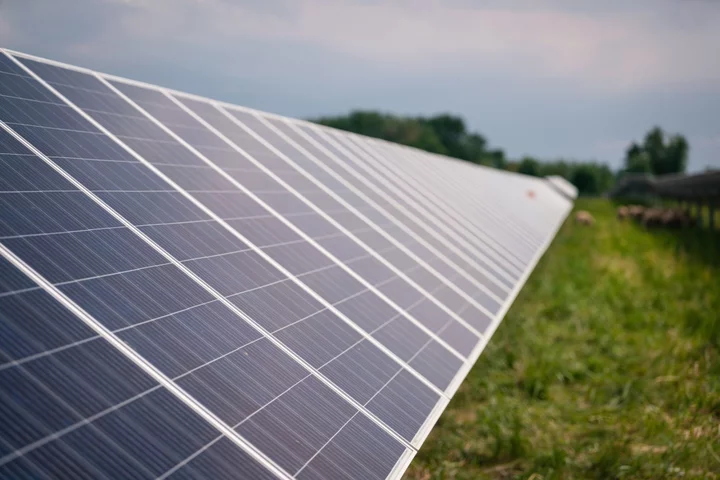
Biden to Announce $60 Million Enphase Energy Investment
President Joe Biden will announce a $60 million investment from Enphase Energy Inc., a manufacturer of solar-energy equipment,
2023-07-06 08:16

'Jeopardy!' fans unhappy with new trivia video game due to monthly fee: 'Not willing to pay $10'
The trivia game was developed by Volley and is available for purchase on Roku devices
2023-07-12 13:22

BP Backs New Fuel for Ships Made Using Everyday Garbage
BP Plc is investing in a California-based startup that will use uneaten food and other waste to make
2023-07-06 13:27

This is what the 'perfect' man and woman look like, according to AI
Artificial intelligence has unrealistic and often dangerous ideas of what the “perfect” man and woman look like, according to a new study. Chiselled features, olive skin and eight-pack abs are among the features that kept cropping up when three leading AI image generators were tasked with creating “ideal” male and female bodies. The challenge was put to the popular programmes Dall-E 2, Stable Diffusion, and Midjourney by eating disorder awareness group the Bulimia Project, which separated its request into two parts. First up, it asked the generators to come up with pictures of men and women based specifically on beauty standards set by social media. Sign up for our free Indy100 weekly newsletter Although it churned out quite a few different options, it showed a number of noticeable biases. Nearly all of the images featured petite women – with Midjourney named as the worst culprit – and all of the men looked like photoshopped versions of bodybuilders. The three AI favoured women with blonde hair and men with brown hair, and nearly half of the male images had facial hair. After analysing their findings based on social media, the Bulimia Project team broadened the scope of the task. This time, they asked the programmes to base their creations on images from across the internet. The main difference between the two categories was that the social media set was “far more sexually charged”, according to the study’s authors. The social media images also featured “largely disproportionate body parts”, which the Bulimia Project described as “unsettling”. “We can only assume that the reason AI came up with so many oddly shaped versions of the physiques it found on social media is that these platforms promote unrealistic body types, to begin with,” it said. “In the age of Instagram and Snapchat filters, no one can reasonably achieve the physical standards set by social media. So, why try to meet unrealistic ideals? It’s both mentally and physically healthier to keep body image expectations squarely in the realm of reality.” Have your say in our news democracy. Click the upvote icon at the top of the page to help raise this article through the indy100 rankings.
2023-05-21 15:46
You Might Like...

Stocks Poised for Muted Open

Vermont reservoir threatens to bring more flooding to state capital

'90 Day Fiance' star Angela Deem dubbed 'old hillbilly' by troll, fans say 'haters are always gonna hate'

Q4 Inc. Introduces First-of-its-Kind IR Event Management App to the Q4 Platform

American soldiers brought breakdancing to South Korea. Now it's writing its own history

Air Mobility Startup Lygg Raises €3.6 Million to Reduce Time and Costs Associated with Business Travel

CS:GO Major Simulator: Best to Use

Keysight Enables Advanced Pre-Tapeout Silicon Prototyping Using Digital Twin Signaling