
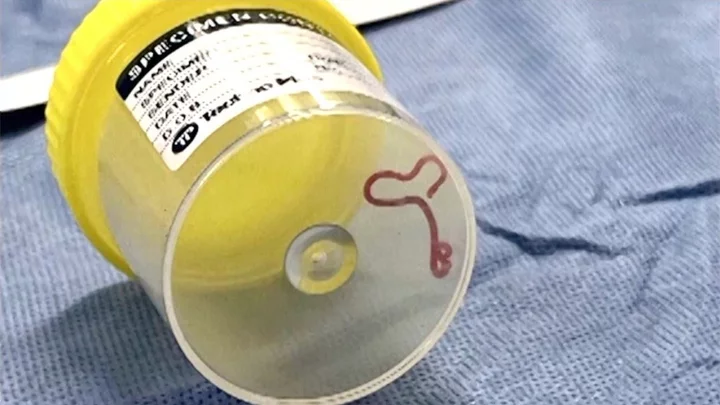
More than 1 billion people worldwide are infected with parasitic worms
After a live worm was found wriggling around in an Australian woman’s brain recently, you could be forgiven for thanking your lucky stars you don’t have a similar parasite living inside you. But it turns out the chances are much more likely than you might think. More than 1 billion people are thought to have threadworms, a type of invertebrate also known as the pinworm, as per a 2019 study by NCBI. Threadworms grow to around 1cm in length and are specific to human hosts. They infect the small intestine, make your bottom feel itchy and can be passed from person to person. They are a common type of infection in the UK, particularly in children under the age of 10. Threadworms are white and look like small pieces of thread – they are usually spotted in people’s poo. According to the NHS website, they can make people irritable and cause them to wake up at night. When things get really bad, they can cause weight loss. The woman in Australia’s worm, by contrast, was found in her brain, and surgeons needed to get it out manually. “Everyone [in] that operating theatre got the shock of their life when [the surgeon] took some forceps to pick up an abnormality and the abnormality turned out to be a wriggling, live 8cm light red worm," said infectious diseases doctor Sanjaya Senanayake, according to the BBC. If you get threadworms, you won’t need to have brain surgery, fortunately. You can buy medicine (mebendazole) for threadworms from pharmacies, according to NHS online. This is usually a chewable tablet or liquid you swallow. The medicine kills the threadworms, but it does not kill the eggs. Eggs can live for up to 2 weeks outside the body. There are other types of worms you can catch, however. Tapeworms, roundworms and hookworms are all relatively common parasites that you can catch from eating raw or undercooked meat. They can also be caught from inadvertently touching infected poo. Roundworms look more like earthworms, tapeworms are long, pale yellow and flat and hookworms, somewhat horrifically, cause a red, worm-shaped rash beneath the skin. Vincent Ho, associate professor and clinical academic gastroenterologist at Western Sydney University in Australia, said that there are four things you can do to avoid these nasty little critters. “Avoid undercooked or raw pork. Freezing meat first may reduce risks (though home freezers may not get cold enough) and it must be cooked to a high internal temperature. Avoid pork if you are travelling in places with poor sanitation,” he said in an article for The Conversation. “Avoid jumping or diving into warm fresh bodies of water, especially if they are known to carry Naegleria fowleri. Although only a handful of cases are reported each year, you should assume it’s present. “Practise good hand hygiene to reduce the risk of rare and common infections. That means washing hands thoroughly and often, using soap, scrubbing for at least 20 seconds, rinsing and drying well. Clip and clean under fingernails regularly. “To avoid soil-borne parasites, wear shoes outside, especially in rural and remote regions, wash shoes and leave them outside.” Sign up to our free Indy100 weekly newsletter Have your say in our news democracy. Click the upvote icon at the top of the page to help raise this article through the indy100 rankings.
2023-08-29 23:26

Has NoPixel banned RatedEpicz? xQc discusses GTA RP streamer's situation, says 'You just don't know what canceling means'
xQc said, 'It was his biggest stream since he created his channel, that's, like, the opposite of being canceled, as far as I am concerned'
2023-07-14 14:21

The best pet cameras for keeping tabs on your cat or dog
If you have a four-legged friend at home, chances are you consider them to be
2023-05-31 00:52

What Is Wi-Fi 6E?
If you're in the market for a new router or any other device that uses
2023-07-08 02:23

Snag two lifetime licenses to Microsoft Office for just $80
TL;DR: As of August 19, get a Microsoft Office lifetime license 2-pack for home or
2023-08-19 17:52

Get a PlayStation 5 bundle for a record-low price
SAVE $60: As of June 7, the PlayStation 5 God of War Ragnarok bundle is
2023-06-07 23:24
To Delete a Threads Account, You'll Need to Nuke Your Instagram Account Too
Mark Zuckerberg is making it hard to delete a Threads account once you sign up
2023-07-06 22:27

WhatsApp could be moving towards usernames instead of phone numbers, new update suggests
WhatsApp may be moving towards allowing people to be found by usernames rather than just phone numbers, according to a new update to the software. The system would let people choose a unique username that could then be used to start new chats. That would allow people to more easily share their contact details without also giving away their phone number. The new update is found in a beta version of the app that has been made available for Android, according to WABetaInfo, which has a track record of finding unannounced features in the app. That beta version shows a part in the settings that allows people to choose a WhatsApp username. “This is your unique username,” the app says, alongside the separate option to choose a name, which is available in the app now and shows alongside messages. The option to select a username will be found within the WhatsApp settings and then the “profile” option, the report indicated. It is inside the latest beta version of the Android app – though is not fully supported even in that system, being still under development and not visible to early testers. There is no real indication of how those usernames might work. WABetaInfo speculated that the system could be relatively limited – such as simply allowing communication with businesses without giving up a phone number to them – to the more general usage as a way to speak to other people on the app. Conversations initiated using usernames appear to keep end-to-end encryption, the report said. WhatsApp has recently rolled out a host of changes intended to protect the privacy of users. Those have included new changes that let people control the information they give up alongside their chats, letting people leave group chats more quietly and allowing people to choose specific people who can see when they are online, for instance. The company has said repeatedly that its aim is to allow WhatsApp conversations to feel like real life, with the privacy and temporary nature that brings. Other related features have included the option to delete messages and edit them after they are sent. Throughout all those changes, however, WhatsApp has always used the phone number as a way of creating and verifying accounts, as well as finding other people on the app. As such, it has meant giving up your phone number in order to talk to anyone, including businesses who may abuse it with spam calls or other marketing. Read More WhatsApp will let you edit messages after they are sent — but there’s a catch Major WhatsApp update enables secret chats WhatsApp unveils new feature to protect ‘your most intimate conversations’
2023-05-27 02:57

Tesla Deliveries Are a Record. The Stock Won’t Go Up.
Tesla delivered 466,140 vehicles in the second quarter of 2023. Wall Street was looking for roughly 445,000 to 447,000 units.
2023-07-03 00:46

The Best Apple Wireless Chargers for 2023
If you're an Apple fan, chances are you have a drawer filled with white wires
2023-09-06 02:22

Nepali sherpa becomes world’s second person to scale Everest 26 times
By Gopal Sharma KATHMANDU A Nepali sherpa guide climbed Mount Everest for the 26th time on Sunday, hiking
2023-05-14 14:53

Akuity Launches an AI Assistant for Argo CD to Help Troubleshoot Common Kubernetes Deployment Issues
SUNNYVALE, Calif.--(BUSINESS WIRE)--Jul 25, 2023--
2023-07-26 03:20
You Might Like...

Zuckerberg Says He's 'Not Holding My Breath' For Fight With Musk

iPhone 15: Rumours hint at what mysterious button on side of new Apple device could do

Bitcoin Dips to Lowest Since March After Falling for a Second Straight Day

United Natural Foods announces partnership with RELEX Solutions to enhance demand planning capabilities and procurement efficiencies

Japan chip tool maker Kokusai Electric raises $724 million in IPO

Bitcoin hits its highest level in a year

Free Final Fantasy 16 demo launches ahead of game's release

Tesla begins sale of cheaper Model Y vehicle in South Korea